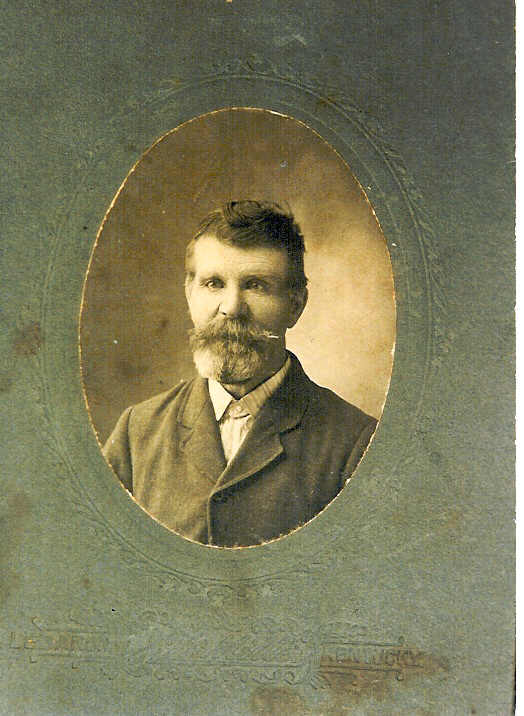
Rev. Thomas S. Major, born July 13, 1844, ordained priest November 14, 1875, appointed pastor Good Shepherd church August 1895, died August 22, 1911. Requiescat in Pace. A member of John Morgan’s Command. C.S.A.
An interesting note for Civil War buffs is the story told by Rev. Thomas Major about why John Wilkes Booth killed Abraham Lincoln! Could it be true?
The State Journal, Frankfort, Franklin County, Kentucky
August 26, 1911
Body of Loved Priest Rests In His Grave
Large Concourse of Mourners at Funeral of Father T. S. Major

All that was mortal of Rev. Father Thomas S. Major was laid to rest in the Frankfort Cemetery yesterday, shortly after the noon hour, and notwithstanding the rainy and inclement weather, it was one of the most largely attended funerals that Frankfort ever witnessed, and one of the most impressive.
Promptly at ten o’clock, at the Church of the Good Shepherd, the visiting priests, about twenty-five in number, began the chant of the Office of the Dead. At its conclusion, Very Rev. Father Ferdinand Brossart, Vicar-General, of Covington, sang the High Mass in the presence of Bishop Maes. When he concluded, Bishop Maes delivered the funeral sermon, in which he gave a short biographical sketch of Father Major’s career as a boy, soldier and priest. He said Father Major had always been true to his convictions of right, and to show that by holding to this rule he had never forfeited the good opinion of any one, he cited the fact that the old Confederate soldiers who fought with him, loved him just as much after he became a priest as they did before.
He said that Father Major had told one of his brother priests only a short time ago of an interesting incident that happened just at the close of the Civil War, that came to his knowledge while he (Father Major) was in Canada. This incident was as follows, and throws some light on the assassination of President Lincoln by Wilkes Booth. While in Canada, Father Major said five Confederates, who had taken refuge in that country, decided to continue the fight by attempting to kidnap President Lincoln; that these five men went to Washington in disguise, but before they did anything, one of them was captures as a suspected spy, and sentenced to be hung or shot. The man was a friend of Wilkes Booth, and the latter went to see President Lincoln in an effort to have the life of his friend saved; that Booth stated afterward that the President granted his request for the reprieve or pardon. For some reason, however, the President’s reprieve order was never delivered to the proper officer, and Booth’s friend, the suspected spy, was executed on Good Friday. According to what one of the other four men afterwards told Father Major, the fact that his friend was executed, incensed Booth intensely, and that night at Ford Theater, he shot and killed the President. Father Major always believed that the assassination of Mr. Lincoln was solely due to Booth’s anger over the idea that the President had not kept faith with him, and had allowed his friend to be executed. Some minor official had probably held up the reprieve, but neither Booth nor Lincoln knew this.
The Bishop paid a high tribute to Father Major’s unswerving devotion to principle and to his religion, and his words made a decided impression on the immense audience that packed the church at the funeral.
At the conclusion of the services at

the church, the male members of the Church of the Good Shepherd and a number of Father Major’s old army comrades, marched in front of the procession to the cemetery, and the hearse was followed by a long line of carriages and vehicles, and many went up on the street cars to witness the ceremonies at the grave.
In addition to the regular church services at the grave, a special dispensation had been granted by Bishop Maes for the confederate burial service to be read, and Capt. James Arnold, of Newport, one of General Morgan’s soldiers, read the service most impressively. Father Jones then concluded the service with prayer.
There were scores and scores of beautiful floral designs placed on the grave by many loving friends of the lamented soldier-priest as a last token of their regard for him who had been their friend.
At the church service, Rev. Thomas Cusack acted as deacon, , Rev. George O’Bryan as sub-deacon, and Father J. L. Gorey as master of ceremonies. Very Rev. James Cronin and Rev. Stephen Schmidt assisted Bishop Maes, Rev. J. A. Hogarty officiated at the Office of the Dead, and Rev. Father P. M. Jones, of Maysville, conducted the services at the grave.

In the August 27, 1911, issue of The State Journal it was noted that, ‘At the time of his death he had been in charge of the Catholic Church at Frankfort for some seventeen years or more. He was one of Gen. Morgan’s cavalrymen during the Civil War and was captured, but escaped from prison, and the Lost Cause had no braver or truer soldier than he. He was wounded and nursed back to life by Catholic sisters, and that caused him to join the Catholic Church and study for the priesthood.’
Father Thomas S. Major was the son of Dr. Francis W. Major and Ellen C. Dudley Major.
And one more notice about Rev. Thomas Major –
Tri-Weekly Kentucky Yeoman, Frankfort, Franklin County, Kentucky
December 4, 1875

Personal – Rev. Thomas Major, son of Dr. Major, formerly of Paris, and a grandson of Porter Smith, was ordained a priest at the cathedral, in Covington, on Sunday, Nov. 28th. He will celebrate his first Mass in the Paris Catholic Church tomorrow. Mr. Major, when but a stripling in years, and in extremely delicate health, joined Gen. Morgan’s command and served through the war on the Confederate side. The rough life of a soldier agreed with him so well, that, to the surprise of all his friends, he came out of the war with the most robust health and strength.
Categories: Obituaries