Broken Bow, Nebraska, is the county seat of Custer County. The town was named for a broken bow and arrow found at an old Indian camping ground. It was platted in 1882 and incorporated as a city in 1888. A small city, it has a total area of 1.9 square miles. A square mile is 640 acres, so about 1,216 acres for the total of Broken Bow.

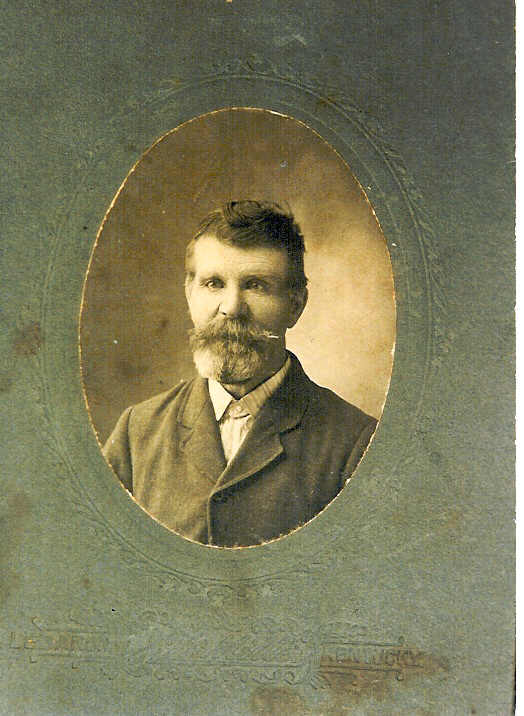
Why do we need to know this information? Ritchey’s great-grandfather, Charles Henry Ritchey, applied for and received the East half of Section 31, Township 19, Range 26 and East half of Section 6, Township 18, Range 26, West of 6th P. Maridian, containing 639.64 acres, within the Broken Bow, Nebraska, land district. Charles had to swear that he did not own more than 160 acres of land in any State or Territory, that he was a native born citizen of the United States and the head of a family and was over twenty-one years of age. His post office address at the time was Callaway, Nebraska. He makes this application ‘honestly and in good faith made for the purpose of actual settlement and cultivation, and not for the benefit of any other person, persons, or corporation; that I will faithfully and honestly endeavor to comply with all the requirements of law as to settlement, residence and cultivation necessary to acquire title to the land applied for; that I am not acting as agent of any person, corporation, or syndicate to give them the benefit of the land entered, or any part thereof, or the timber thereon; that I do not apply to enter the same for the purpose of speculation, but in good faith to obtain a home for myself, and that I have not directly or indirectly made, and will not make, any agreement of syndicate whatsoever, by which the title which I may acquire from the Government of the United States will inure in whole or in part to the benefit of any person except myself. I further swear that since August 30, 1890, I have not entered and acquired title to, nor am I now claiming, under an entry made under any of the nonmineral public-land laws, an amount of land which, together other than the homestead laws, more than 160 the aggregate 320 acres; and that I have not heretofore made any entry under the homestead laws, that I am well acquainted with the character of the land herein applied for and with each and every legal subdivision thereof, having personally examined same; that there is not to my knowledge within the limits thereof any vein or lode or quartz or other rock in place bearing gold, silver, cinnabar, lead, tin, or copper, nor any deposit of coal, placer, cement, gravel, salt spring, or deposit of salt, nor other valuable mineral deposit; that no portion of said land is claimed for mining purposes under the local customs or rules of miners, or otherwise; that no portion of said land is worked for mineral during any part of the year by any person or persons; that said land is essentially nonmineral land, and that my application therefore is not made for the purpose of fraudulently obtaining title to mineral land; that the land is not occupied and improved by any Indian.’

This application is dated August 3, 1910, and is signed by Charles H. Ritchey – his signature that of an older man. Charles was 62 years old at this time.

But an interesting thing happened. December 17, 1910, four months after receiving this land, Charles Ritchey signed it back to the United States. He relinquished his land. I believe something must have happened for there to be such a quick turnaround. Eighteen months later Charles was dead. I believe he must have found out he was seriously ill and knew he couldn’t properly take care of 639+ acres. Of his 8 children only Francis Sumber Ritchey, my Ritchey’s grandfather and the youngest of the children, lived in Custer County, where he met and married his wife Edith Margaret Klein June 7, 1910. Charles and wife Lucinda Jewell Ritchey moved to Custer County after the 1900 census which showed them living in Fillmore County, Nebraska. According to the birth records of their children they arrived in Fillmore County before September 1882, when daughter Edith Helen was born there.

Charles Ritchey held a public sale at his residence in Fillmore County March 18, 1902. He sold horses, cattle, hogs and various pieces of farm machinery. I believe they must have left for Custer County shortly after this date. It is 146 miles from Fairmont to Broken Bow. I’m sure they traveled in wagons and on horseback. How long did it take to get there? Google Maps says it takes 52 hours to walk that distance. A week and a half?

A notice in the Geneva newspaper of September 19, 1912, says that Charles Ritchey, of Kingfisher, Oklahoma, came Saturday to join his wife who is visiting Geneva relatives and friends. He had been at Calloway, Nebraska, visiting his father who is in poor health. Daughter Mary lived in Washington state. Son Elmer Cross Ritchey lived in Malheur, Oregon. James Eben, Edith Helen, Zillah Maude and Arthur Ritchey lived in Fillmore County.

When Charles Ritchey died October 25, 1912, his body was brought to Fillmore County and buried in Geneva Cemetery. Wife Lucinda lived the rest of her days with her children in Fillmore County.

Charles Ritchey was a traveling man – 417 miles from his birthplace to his final resting place. He was born in Schuyler County, Illinois, April 14, 1848. There he married Lucinda Amanda Jewell February 4, 1875. Their first three children were born there – Charles Thomas, Mary Emma and James Eben. Son Elmer Cross Ritchey was born in Corydon, Iowa, January 13, 1882 – on their way to Nebraska! The last four children, Edith Helen, Zillah Maude, Arthur W. and Francis Sumber were born in Fillmore County, Nebraska. What an interesting trek across our country at an even more interesting time in history!
Categories: Family Stories