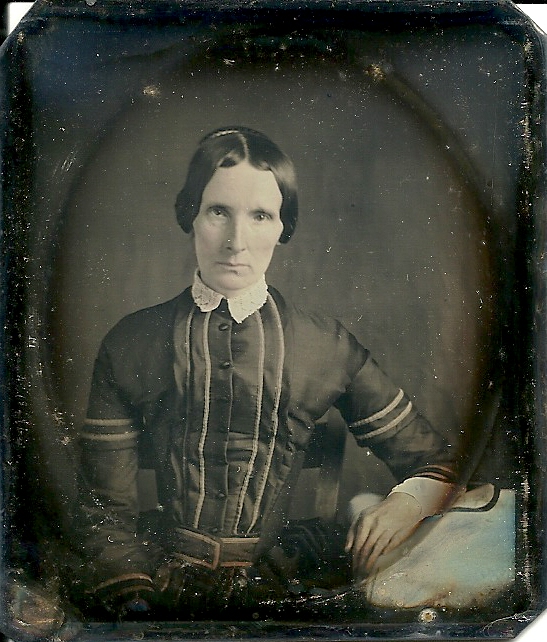
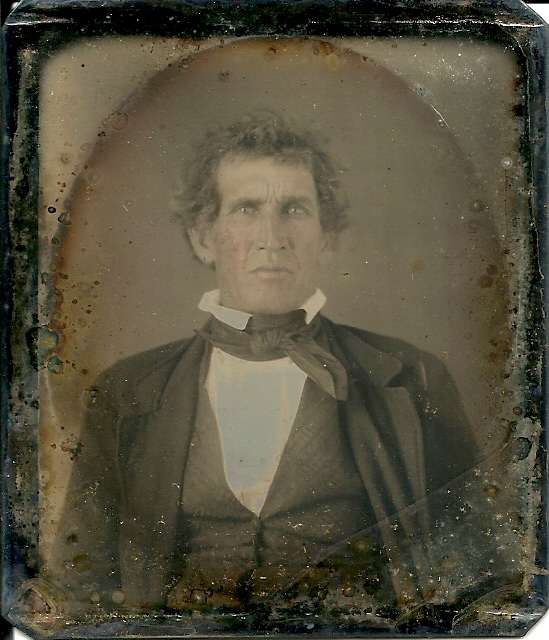
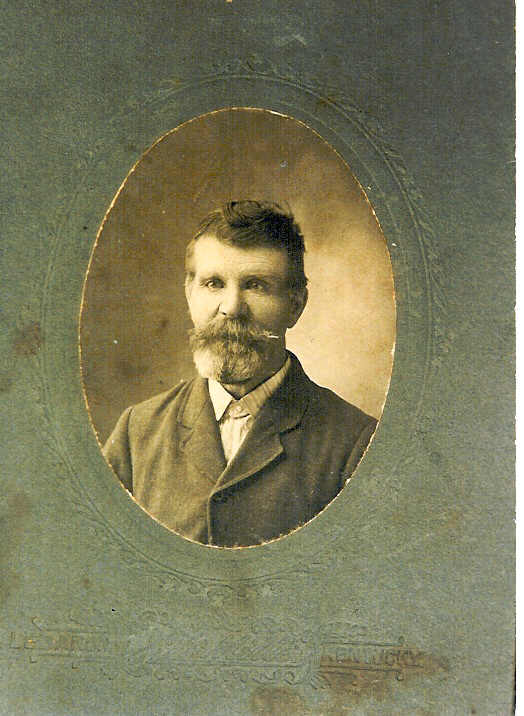
My 2nd great-grandparents, Emeline White and William Coulter, married April 26, 1851, in Washington County, Kentucky. William was the son of Mark Coulter and Nancy Taylor; Emeline the daughter of Samuel Riley White and Martha Lewis. In the ten years of marriage they enjoyed together before the war the couple had three children – Martha Ann, born January 23, 1852, married Marion Crow August 1, 1869, died before 1900; George F. Coulter, born December 23, 1854, married Mary Elizabeth Crow, March 26, 1874, died December 2, 1909; Nancy M. Coulter, born June 24, 1861, married Newton Barnard December 24, 1878. George and Mary Elizabeth are my great-grandparents.
William fought in the Civil War on the Union side in Company H of the 4th Infantry, enlisting at Camp Dick Robinson in Garrard County, October 9, 1861. August 17, 1863, he is on the rolls in Macon, Georgia. He was injured during the Battle of Chickamauga fought September 18-20, 1863, a wound to his right forearm.

He was captured and held at Andersonville Prison. He was exchanged April 1 through 5 in 1865. He was paroled at Vicksburg, Mississippi April 10, 1865 and admitted to hospital at the parole camp for diarrhea.

William Coulter returned to duty April 11, 1865, and died on the Sultana April 27, 1865.

In his wartime paperwork he is listed as prisoner of war from July 30, 1864, until April 10, 1865, when he was paroled.

William and many other prisoners of war and others boarded the Sultana, a steamship, April 27, 1865, for the journey home. When the Sultana was on the Mississippi River, about a mile above Memphis, Tennessee, a boiler explosion killed William and many others.

Chicago Tribune, Chicago, Illinois
Saturday, April 29, 1865
One of the most terrible disasters which has ever occurred on western waters took place near Memphis a day or two since. The steamer Sultana, with two thousand exchanged Union prisoners from Vicksburg, on their way home, and one thousand civilians, exploded her boilers, burned and sunk. Out of the entire number on board between five and seven hundred only were saved. This fearful calamity is the more appalling from the fact that so large a number of the victims were our brave soldiers just escaped from the horrors of the Southern prison pens only to meet death at the very threshold of home.

The following is the Memphis Bulletin’s account of the disaster to the steamer Sultana:
Captain Mason arrived from New Orleans last night, the 26th, with about 2,200 people on board, 1,964 of whom were exchanged Federal prisoners from Vicksburg, the balance being refugees and regular passengers from various points down the river. Proceeding towards St. Louis she left the coal pile about one ’’clock in the morning, and had made some eight or ten miles, when an explosion of one of her boilers occurred. The boat, with it’s mass of living freight, took fire in the vicinity of the engine, and in a short time she was burned to the water’s edge, and now lies on a sand bar near Fogleman’s Landing, with nothing visible but her charred remains and her jackstaff standing erect.
The scene following the explosion was terrible and heart rending in the extreme, hundreds of people were blown into the air, and descending into the water, some dead, some with broken limbs, some scalded, were borne under by the resistless current of the great river, never to rise again. Survivors represent the screams as thrilling. With no immediate succor at hand, the desperate efforts to save life were agonizing beyond precedent. Some clung to pieces of the wreck, as drowning men cling to straws, and sustained themselves for a few moments, but finally became exhausted and sunk. Only the best of swimmers, aided by fragments of the wreck, were enabled to reach the woods, and there take refuge until rescued by boats sent from the landing here to their assistance. There were about fifteen women and children aboard, and as near as can be ascertained, not more than two or three had been found at the hour when this account was written. Some of the wrecked people were borne by the current as far down as the Levee at this city, and this was the first intimation officers of the boats in port received of the terrible disaster. A yawl was immediately sent out from the Marble City, and in a few minutes seventeen persons were picked out of the water and brought to shore. Two were afterwards found clinging to the wheel, and they were also saved.
Upon being brought to a realization of the calamity, the officers of boats in port, under notification of Capt. Senior, of the river guard, steamed up, and in a short time were at the burning steamer, where hundreds of people were picked up and brought to this landing, arriving, about daylight. They were met by numbers of citizens and ladies, who supplied them with abundance of dry clothing from the Quartermaster’s Department and from various stores.
At this time it is impossible to give a correct statement of the cause of the accident, and the number or names of the lost and saved. Every thing is in the greatest confusion. Rowberry, the first mate, was on watch, standing in the pilot house with Capt. George Clayton, who was at the wheel at the time of the explosion. He only remembers the shock, and that he was blown into the air, and was afterwards taken from the water. He saw the lower deck in flames and knows no more. He can give no idea of the cause of the accident, and says the boat was going at ordinary speed, and that all seemed well up to the moment the explosion occurred; that the second engineer, a sober reliable man named Clemens, was at the engines, and that nothing more than common was in progress. Captain Cayton was also hurled into the wreck among broken boilers and rubbish, sustaining slight injuries. He immediately jumped overboard with a door, by which he was enabled to reach the Arkansas shore, three miles below, where striking a sapling he seized and clung to it until saved. Clemens, the engineer, was badly burned and scalded, and can hardly recover.
Mr. John Fogleman, residing on the Arkansas side, on being aroused by the noise and seeing the burning steamer, hastily constructed a rude raft, and in this way was the means of saving about 100 lives.
In the woods among the drift of the wreck the officers of the Rose Hambleton found a family bible containing the records of a family named Spike, of Assumption Parish, Louisiana. The names recorded are Samuel D. Spike and Elithea Spike, married October 31, 1837. The record shows that there were twelve in the family. It was subsequently learned that the father, mother, three daughters, two brothers and a niece were lost. Several of the bodies were recovered. This family had $17,000 in gold, all of which was lost.
The steamer Bostona No. 2, Captain Watson, was coming down the stream from Cincinnatti when the explosion occurred, and rendered very valuable assistance, saving many lives. The Pocahontas, Silver Spray, Marble City, gunboats Essex, Rose Hambleton and others also rendered much service at the time of the explosion. Capt. Mason had retired from his watch and was in bed. He was afterwards seen throwing shutters and doors to the assistance of people in the water, and here all traces of him vanish. Clerks Gamble and Stratton are also missed.
The Sultana was officered as follows: Master, J. C. Mason; First Clerk, W. J. Gamble; Second Clerk, William Stratton; Pilots, George Cayton and Henry Ingraham; Engineers, Nathan Wintenger and Clemens; First Mate, William Rowberry; Steward, Henry Cross. George Clayton and William Rowberry were the only ones known to be saved, except Clemens, who is almost dead.
The body of Wm. Cruddes, Company I, 1st Virginia Cavalry, from Wheeling, Virginia, was found. He had taken the precaution to label himself. Among the soldiers on board were thirty commissioned officers. The troops were of various regiments, and nearly all exchanged prisoners. They belonged principally to Western regiments.
At the hour of writing only 500 or 600 person had been saved. Not less than 1,000 lives were hurled into eternity by this most melancholy of river disasters. Hon. W. D. Snow, member of Congress from Arkansas was on abord and assumed dead.
Should we call it irony? That cruel twist of fate, especially for the soldiers who had spent almost two years imprisoned in horrible conditions, their hopes and dream of home almost realized when all was shattered by the explosion that killed the majority of them.

Emeline Coulter filed for her widow’s pension September 29, 1865. She had three children to raise. Emeline received William’s pension of for 47 years, ending at her death on February 26, 1912. The pension was $8 per month, plus an additional $2 per month for each child until they reached the age of 16 years, beginning July 25, 1866. As you can see in the last installment she received her pension had been raised by $4 a month in 47 years!

Emeline lived in Washington County until the end of her life when she lived with youngest daughter Nancy and her husband Newton Barnard in Bullitt County, Kentucky.

Categories: Family Stories