
Today, April 20, 2026, Kentucky Kindred Genealogy is 15 years old! When I started writing about genealogy and my findings, I thought no one would read it! But to my surprise you do! I have met so many wonderful people, and many of you have become good friends! It just goes to show that genealogy is an important subject to many. After all, our family is most important in life!
At first my posts were about my family and the new finds I made. But then I expanded it to all Kentucky and those settlers who came to the state in the early years before we were a state! Both sides of my family have been in Kentucky since the very early days. Before that they were in Virginia, Maryland and North Carolina – all before the revolution. I have no recent ancestors that came to the United States in the 1800’s or later. After a bit of search we found Ritchey had family not only in Nebraska, his mother’s line, but also Missouri, Illinois, Iowa and Maryland. He has the very early ancestors, but also those that came to the United States in the mid-1800’s. Our trips were a bit further from home, but oh so interesting!!
I researched for others a few years before beginning the blog, but afterwards I have spent much time on many other families, finding and building family relationships, and meeting wonderful people along the way – and introducing them to new members of their family. I love to help others in their research as much as I do my own.
Through the years I have become rather adept at reading the old handwriting in those beautiful deeds and wills. Like anything else, the more you do something the better you become at it! Old Kentucky books on history, marriages, wills, deeds, cemeteries, etc., are my passion, and in the last six years I have accumulated enough to fill my library. With those I research for others as well as for our families. I also own books from Maryland, Virginia, Nebraska, North Carolina, Iowa and Missouri, though not as many my Kentucky books.

One of our most exciting adventures was in 2023 when, after our move to Michigan in 2020, we came back to Kentucky to visit family, friends – and cemeteries! While here, Billy Wilkerson came to the Linton family cemetery to use ground penetrating radar to determine the number of people buried in the cemetery – only seven stones mark graves. We found 32 more graves for a total of 39 burials.
Ritchey and I have been to every county in Kentucky and photographed at least one cemetery – most of the time several in each county. Our total number of gravestone photos is over 40,000. And, yes, I do have a list, by county, of all cemeteries visited, and the number of photographs taken in each.
WordPress keeps great records. I’ve written 4,474 posts over the last 15 years. For April 16, 2026, I had 515 views with the most people from the United States reading my posts, but also from Hong Kong, Singapore, Belgium, China, Canada, Australia, Mexico, South Korea, Italy, United Kingdom, Spain and Brazil. How is that possible?
The top ten posts were surprising!

History of the Black Wedding Dress, written December 13, 2014, comes in first with 16,672 views! It features a beautiful photograph of a bride and groom, both very well dressed. But the bride is wearing a black wedding dress with a white veil! She is very stunning. Yesterday 35 people checked out this post. That is truly amazing when you consider it was posted twelve years ago!

A Study of Men’s Neckwear – 1860’s to 1870’s comes in second with 13,901 views. These are old photos found during our trips to antique stores. But the first is of my third great grand uncle John Linton Edwards, sporting a tie, wrapped around his neck and tied tightly. His photo was taken about 1856 – one of the old, old photographs. The other gentlemen have various ties seen through the years – one has a colorful silk cravat. This post was written May 31, 2013.

Number three is A Kentucky Feud that Doesn’t Involve the Hatfield’s and the McCoy’s! with 10,387 views. This is one of my earliest posts from March 10, 2012, less than a year after beginning the blog. It is short and sweet with a picture of my great-grandparents Isaiah Hill and Lydia Ann Ross. It was Isaiah’s father, for whom he was named, that was killed March 13, 1852, in Garrard County, along with his two brothers, Russell and Frederick. The opposing faction also suffered losses. There are several blogs written about the Hill family – my maiden name.
Pioneer Soldiers in Kentucky 1778-1781 was read by 8,842. It simply lists the names of Col. John Bowman’s soldiers. It gives the names of so many pioneers who fought in the Kentucky militia in the early years. Those listed under Captain Joseph Bowman, Captain Benjamin Logan, Captain William Harrod, Captain John Boyle, Captain John Holder, Captain Isaac Ruddle and Captain Squire Boone are named. 5,398 views for this post written August 4, 2019.
100 Years of Washington County Marriage Records was posted January 26, 2019. I was trying to allow readers to go to my Excel spreadsheet on Kentucky marriages. 4,459 looked at my information. It didn’t work as I thought it would, which is why I started writing books on marriages and other genealogy titles.
Early Marriage Records Database was another adventure in trying to give more information. 4,209 viewers checked what I shared on February 14, 2019. This finally became first my Kindle books, and then paperbacks.
The History of Marion County – my home county – comes in eighth with 3,872 views. This history was written by W. T. Knott. I worked for the public library the summer after my senior year in high school. One of my jobs was to type an extra copy of this 100 page book. There were no copy machines in 1975 – as many of you know! I found it fascinating. And what was typing one more copy for you? The first part was posted September 4, 2013.
Number nine is The McAfee Brothers – Early Kentucky Pioneers. Written May 19, 2019, this was an old newspaper article from 1888 which I shared, written by W. H. Perrin who helped write the biographies of many Kentuckians in the 1880’s. James and Robert McAfee and several others came to explore the new area of Kentucky. They left Botetourt County, Virginia, May 10, 1773, and laid claim to land on the Salt River, about six miles from the new settlement of Harrodsburg.

And number ten is Memorial Acre at Fort Harrod. Written May 19, 2019, the same day as #9, a plot of ground adjoining the first cemetery of Kentucky, at Old Fort Harrod. Within this plot of land are buried Garrett Terhune, of New Jersey, a member of Seely’s Regiment in the New Jersey Militia during the Revolutionary War; George Buchanan from Augusta County, Virginia; James Ray, a captain in the Virginia Militia during the Revolutionary War; three members of the McGohon family, Mark McGohon, Jr., was the first to be buried here, his wife, Elizabeth Dunn McGohon, and daughter Nancy McGohon. Three stones for the Rose family – Capt. Lewis Rose, his wife Mary McMurtry Rose, and son Charlie S. Rose. There is also a plaque commemorating all revolutionary soldiers who are buried in Mercer County – a total of 55!

I would like to thank all of you for visiting my blog and reading my material!! You always make my day! What shall we discuss and study for the next fifteen years? Let me know if you have suggestions!
Categories: Family Stories


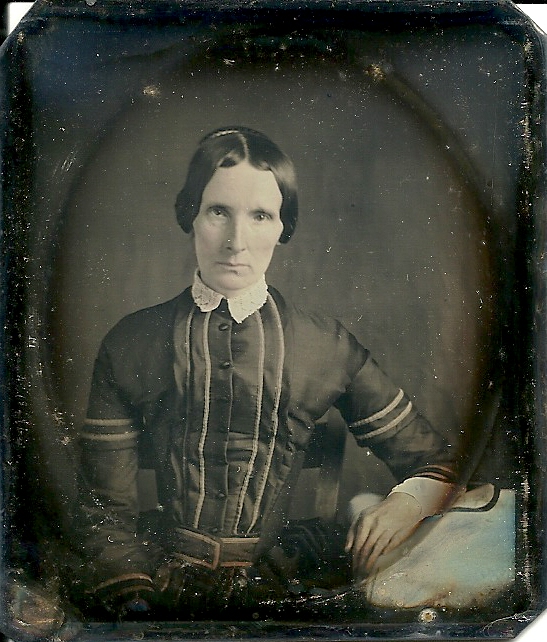
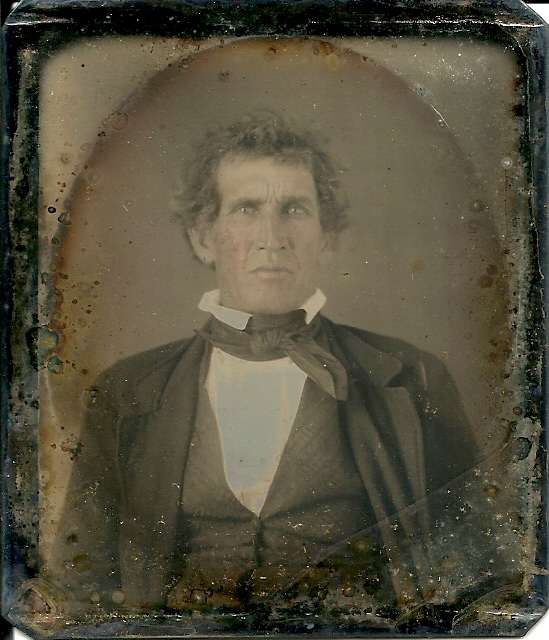


I’m using artificial intelligence to help me date photos.
For information only…
This is a remarkable portrait of **Isaiah Hill** and **Lydia Ann Ross**, capturing a weathered yet resilient look at early 20th-century life. The photograph provides several clues about their status and the period in which it was taken.
## **Visual Characteristics & Composition**
* **The Setting:** The couple is posed in front of a painted studio backdrop, likely depicting a forest or garden scene with stylized trees. This was a standard practice for professional photographers during the late 19th and early 20th centuries to provide a more “elegant” setting than a plain wall.
* **Lighting and Texture:** The lighting is soft and frontal, typical of early studios, which highlights the deep lines and texture in their faces. This detail emphasizes the physical toll of a life likely spent in agricultural or manual labor.
* **Physical Features:** * **Isaiah:** He sports a full, white “spade” beard, which was a common style for older men in the mid-to-late Victorian and Edwardian eras. His expression is stern and direct.
* **Lydia Ann:** She has her hair pulled back in a practical, tight bun, consistent with the modest styles for older women of the time.
## **Clothing and Symbolic Details**
* **Isaiah’s Attire:** He is wearing a dark, heavy coat over a simple, light-colored button-down shirt. The lack of a tie or a formal waistcoat suggests a “Sunday Best” outfit that remains rooted in a practical, working-class lifestyle.
* **Lydia Ann’s Attire:** She wears a dark, possibly silk or taffeta dress with vertical pleating or “tucks” on the bodice. This was a popular design element that added texture to monochromatic clothing.
* **The Commemorative Ribbon:** Perhaps the most interesting detail is the **white ribbon and medal/pin** pinned to Lydia Ann’s left shoulder.
* In this era, such ribbons were often associated with temperance movements (like the WCTU), religious organizations, or a “Gold Star” style recognition for a family member’s military service.
* Alternatively, it could be a badge from a specific local fair, an anniversary celebration, or a fraternal organization.
## **Technical Preservation**
The photo appears to be a **Silver Gelatin print** or a late-stage **Albumen print**, given the sepia-toned aging. There are some minor surface abrasions, “silvering” (the metallic sheen in the dark areas), and small stains (foxing) common in photos of this age, but the clarity of their facial features remains exceptionally high.
### **Genealogical Context**
Based on the visual evidence, this photo likely dates between **1905 and 1915**. The style of the clothing and the maturity of the subjects align well with the late Edwardian period.
If you’d like to look deeper into their history, do you know if the ribbon on Lydia’s dress corresponds to a specific organization or event they were involved with?
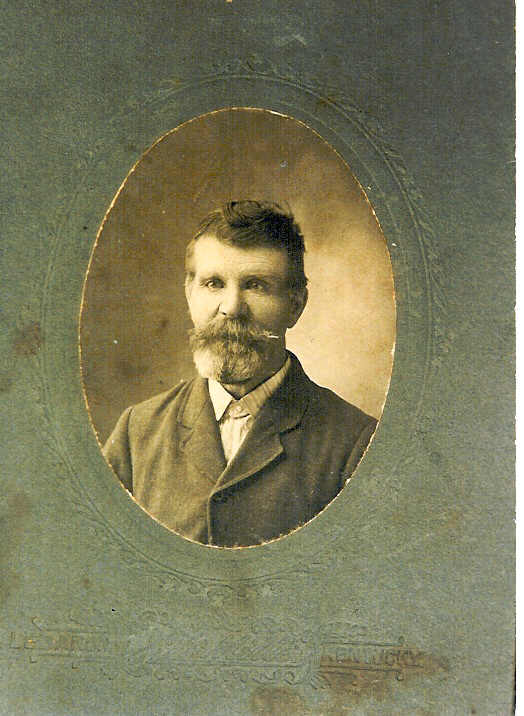
The other one.
This is a striking mid-19th-century portrait that carries the hallmarks of early photographic processes, likely a **daguerreotype** or an early **ambrotype**. The image provides several historical clues regarding the era and the subject’s status.
### Photographic Medium and Condition
* **The Plate:** The “halo” effect around the subject and the tarnishing at the edges are characteristic of a daguerreotype (an image on a silvered copper plate). The dark, oxidised spots and the metallic sheen suggest the plate has been exposed to air over time.
* **The Format:** The curved, arched framing visible in the tarnished area indicates this was originally housed in a decorative brass mat and a protective leather or wooden case, which was standard for portraits from the 1840s through the 1860s.
### Fashion and Dating
Based on the clothing, this photo likely dates to the **late 1840s or the 1850s**:
* **The Cravat:** He is wearing a wide, dark silk cravat tied in a loose knot (often called a “stock” or “bow”). This style was very popular mid-century.
* **The Collar:** The high, stiffened “poke” collar, which points outward toward the jawline, is a classic feature of 1850s men’s fashion.
* **The Waistcoat and Jacket:** He is wearing a dark, high-buttoned waistcoat (vest) under a frock coat with wide lapels. The heavy fabric suggests a formal or professional standing.
### Physical Features and Expression
* **The Gaze:** Like many portraits of this era, the subject has a very intense, fixed stare. This was often a result of long exposure times, where the subject had to remain perfectly still for several seconds to avoid blurring.
* **Facial Features:** John Linton Edwards is depicted with rugged, well-defined features. His hair is styled in a way that was common for the era—relatively long on the sides and swept somewhat forward, reflecting the Romantic influence of the mid-1800s.
### Historical Context
Portraits like this were significant investments. Sitting for a daguerreotype was an intentional act of legacy-building. The clarity of his expression, despite the age of the plate, offers a very direct “connection” to the mid-19th century.
Would you like me to look into any specific historical records for a “John Linton Edwards” from this period to help narrow down his biography?
Thank you, Phyliss for all of the work you have done. It has been an amazing contribution to our genealogy work. I continue to rely on much of your published work in my own efforts to document my Washington County family.
I am still looking for the father and mother of my 3rd paternal great-grandfather George Gootee who was born in Maryland. I think he’s your ancestor too. He married Mary Polly Burns (Byrns). He died 30 Nov 1862 in Springfield, Kentucky. Buried at St. Rose. Will you please help me?
Thank you,
Donns Jones
Congrats on your milestone. You are appreciated. From a follower – home county, Logan County. Transplanted to Florida in 1968. One of my fondest Kentucky memories: Logan County sat on the Tennessee line and was dry. When we visited Tennessee, and then drove back to Kentucky, there was a huge billboard at the state line that read, “This is your last chance before the state line.” Meaning your last chance to buy liquor in Tennessee. Guessing they did not know there was bootlegging in Kentucky. Someone should write a country song about that!
Thank you Phyliss for all these years of interesting posts and information. Your library sounds wonderful. Your website is just full of beautiful pictures and information. I try to read the old wills when you post them and like you I think I’m doing pretty good but then when you type them out for us it is so much easier to read. Thank you for all you do for us.
Thank you so much for your writings. My cousin and I made several trips to the Linton cemetery to hack away at head-tall weeds before the church bought the land and have kept it so nice. I’m related through the Moran- Keene line. One possible suggestion is to explore the darker side of our past- our African American family.I’ve had some contacts through AncestryDNA. Again, thanks for sharing your experiences.
I found your site a few years ago while looking for some of my Kentucky ancestors, the Haydens, Hills, Hamiltons … from Maryland. I don’t recall knowing that your maiden name was Hill. My mother was born Hill. She was descended from the Hill family group that (possibly) left Kentucky for Perry, Missouri for a brief sojourn before coming to Texas in about 1854.
A different line of my mother’s were the Ezell’s, originally from Virginia, then to Trigg County, KY (a land grant for a Revolutionary War Patriot). The DAR put a marker at his grave. My direct Ezell ancestor (a son of the Patriot) went from Virginia to Nashville in 1800 and my direct ancestors finally made it to Texas in about 1883.
On my father’s side a direct ancestor (John “Jack” Ward) died in Logan County, KY, 1810, but I don’t have his burial information. His son who was my direct ancestor married there, but I have not been able to find the Marriage Record … James Ward and Elizabeth Freeman, supposedly married in Logan County in the 1817, moved to Missouri about 1819, and thence to Texas in 1837. Free land had its draw to Texas for several of my ancestors!
I really enjoy your Kentucky Kindred information and want to congratulate you on 15 years!
Thank you for all your hard work. My dad was born in Owensboro in 1904, James Alfred Claycomb. He is descended from early Breckinridge County people and Union County. I so enjoy tracking these brave people. My mom is from French Canada and Irish Canada in Ontario. I read the book “Boone” that you suggested and loved it! Thank you for your love of history! Carol Knox (Chesterfield, Michigan)
Happy Birthday and there be many more! Thanks!